
Health Insurance Cost Estimator
Estimate Your Monthly Cost
Potential Savings:
You could save £0 per year by adjusting options
When you hear health insurance in the UK, most people immediately think of the NHS. And for good reason - the National Health Service gives nearly everyone in the country free care at the point of use. But what if you want faster access, more choice, or private rooms? That’s where private health insurance comes in. And yes, it costs money - monthly, every year, sometimes a lot more than you expect.
How Much Does Private Health Insurance Cost Per Month in the UK?
The average monthly cost for private health insurance in the UK in 2025 is between £50 and £150 for an individual. But that’s just the starting point. A 35-year-old non-smoker in London might pay £65 a month for basic cover. A 55-year-old with a history of high blood pressure in Manchester could pay £180 or more. Age, location, health history, and the level of coverage you pick all change the price.
Basic plans usually cover hospital treatment for acute conditions - things like surgery for a hernia, knee replacement, or cancer treatment. They often exclude things like chronic conditions, mental health care, or routine check-ups. If you want those added, your bill jumps. A mid-tier plan with mental health support, physiotherapy, and specialist consultations can easily hit £100-£130 a month. Top-tier plans that include dental, optical, and global coverage? Those can run £200-£300 a month.
What’s Covered and What’s Not?
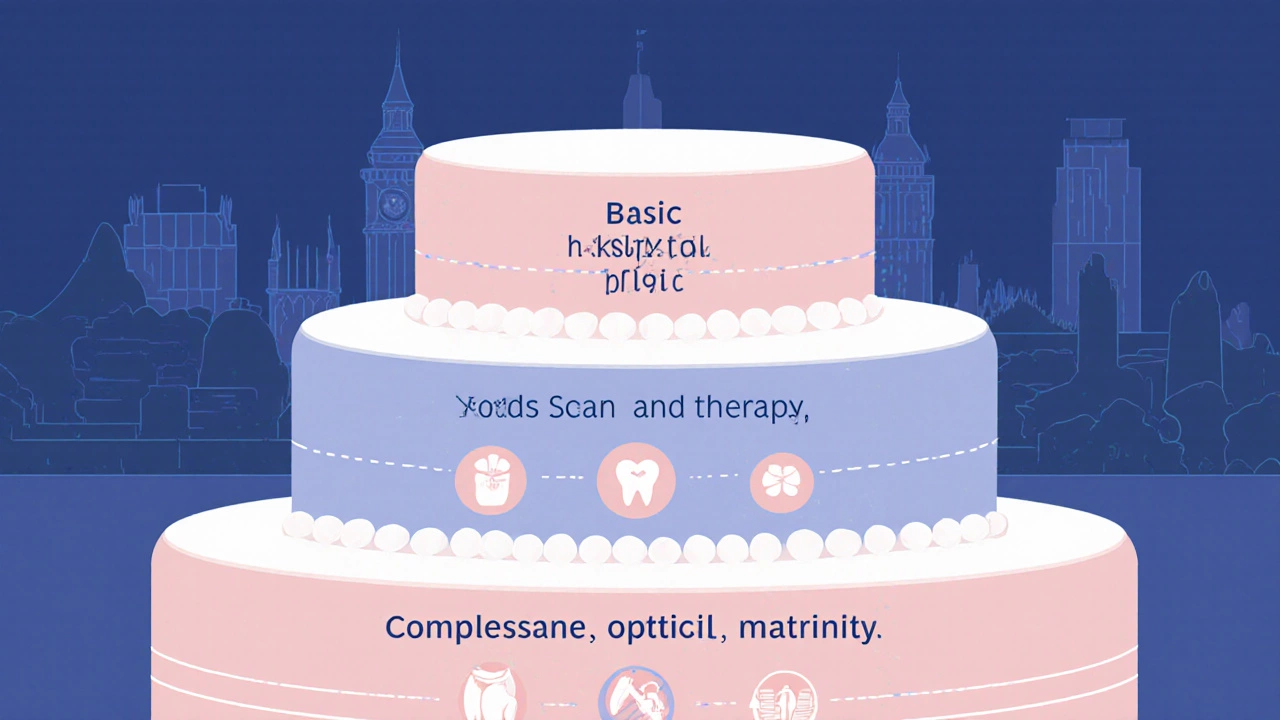
Private health insurance in the UK isn’t one-size-fits-all. Most policies are split into three levels: basic, standard, and comprehensive.
- Basic: Covers inpatient care only - things you’d be admitted to hospital for. No outpatient visits, no diagnostics unless linked to hospital treatment.
- Standard: Adds outpatient care - GP referrals, specialist consultations, MRI and CT scans. Some include physiotherapy and mental health therapy sessions.
- Comprehensive: Includes everything above plus dental, optical, maternity care, and sometimes alternative therapies like acupuncture. Some even offer international coverage.
What’s almost always excluded? Pre-existing conditions. If you had diabetes, asthma, or back pain before you took out the policy, it won’t be covered - at least not for years, if ever. Chronic conditions like rheumatoid arthritis or depression are often left out unless you pay extra. And don’t assume your insurance will cover every specialist. Many policies only let you see doctors in their network.
NHS vs Private: What’s the Real Difference?
Many people think private insurance means better care. It doesn’t always. The NHS has world-class specialists, cutting-edge equipment, and doctors trained to the same standards. The difference isn’t quality - it’s speed and control.
On the NHS, a hip replacement might take 6-12 months to schedule. With private insurance, you could be in surgery within 2-4 weeks. You get to choose your consultant, your hospital, and often your room. No shared wards. No long waits in emergency departments. For people with busy jobs, families, or chronic pain that worsens over time, those weeks matter.
But here’s the catch: private insurance doesn’t replace the NHS. It supplements it. You still go to your GP through the NHS. You still get emergency care for free. Private insurance is for elective procedures - the ones you plan for, not the ones that ambush you.
Who Buys Private Health Insurance in the UK?
Most people who have private health insurance get it through their employer. Around 10% of the UK population has some form of private cover, and most of that comes from workplace packages. If your employer offers it, you’re likely paying less than if you bought it yourself - sometimes as little as £20-£40 a month.
Individuals who buy their own policies tend to be middle- to high-income earners, often over 40, who’ve experienced long NHS waits. Some use it for peace of mind. Others use it as part of a broader health strategy - getting annual scans or early cancer screenings that the NHS doesn’t routinely offer.
It’s not just for the rich. A 2024 survey by the Health Foundation found that 62% of people who bought private insurance did so because they feared delays would make their condition worse - not because they wanted a luxury experience.
How to Lower Your Monthly Premium
If £100 a month feels steep, you’re not stuck. There are ways to bring the cost down without giving up all the benefits.
- Choose a higher excess. This is the amount you pay out of pocket before the insurer steps in. Raising your excess from £250 to £1,000 can cut your premium by 20-40%.
- Limit your hospital list. Some insurers give you a list of 50+ hospitals. If you’re okay with just 10-15 nearby ones, your price drops.
- Pay annually. Paying monthly often adds a 5-10% fee. Paying once a year saves you money.
- Go for joint or family plans. Two adults on one policy can be cheaper than two separate ones. Family plans with kids often cost less per person.
- Stay healthy. Some insurers offer discounts if you track your steps, quit smoking, or maintain a healthy BMI through their app.
One woman in Bristol cut her £120 monthly bill to £75 by switching to a plan with a £500 excess and limiting her hospital choices to three nearby private clinics. She still got her knee surgery in three weeks - and saved £540 a year.

Is It Worth It?
Is private health insurance worth the cost? It depends on what you value.
If you’re young, healthy, and okay waiting 6 months for a specialist appointment, you probably don’t need it. The NHS does a great job for most people.
If you’ve been on a waiting list before. If you’ve had to delay treatment because of long waits. If you want to choose your surgeon or avoid a shared ward - then yes, it’s worth considering.
It’s not a luxury. For many, it’s a practical tool to manage pain, regain mobility, and avoid the stress of uncertainty. The monthly cost isn’t just a number - it’s an investment in your time, comfort, and control over your own body.
What Happens If You Can’t Afford It?
You’re not alone. Many people can’t afford private insurance - and that’s okay. The NHS still covers everything you need. If you’re struggling with long waits, you can ask your GP for a referral to a faster private provider through the NHS e-Referral Service. Some NHS trusts have deals with private hospitals to reduce backlogs. You don’t pay anything - the NHS covers it.
There are also charities and patient assistance programs that help with specific conditions - like cancer support groups that arrange private scans or physiotherapy for those who qualify.
Private insurance isn’t the only path to faster care. But for those who can afford it, it gives back something the NHS can’t always offer: predictability.