Cosmetic vs. Drug Product Classifier
How is the product marketed?
Select the primary claim made by the manufacturer.
You walk down the aisle at your local pharmacy or browse an endless feed on social media. You see moisturizers, serums, foundations, and cleansers. They all promise to improve your appearance, protect your skin, or make you smell great. But have you ever stopped to ask what these items actually *are* in a legal and scientific sense? The term cosmetic products sounds simple, but its meaning is surprisingly specific-and it dictates everything from how they are made to whether they can legally claim to cure acne.
Understanding the true definition of cosmetics isn't just academic trivia. It changes how you read labels, how you assess safety claims, and why some products require a doctor's prescription while others sit on a shelf next to candy bars. Let’s break down exactly what constitutes a cosmetic product, where the lines blur with drugs, and what this means for your daily routine.
The Legal Definition: What Makes a Product a Cosmetic?
In the world of regulation, definitions matter more than marketing buzzwords. According to major regulatory bodies like the U.S. Food and Drug Administration (FDA) and similar agencies globally, a cosmetic product is defined as any substance intended to be rubbed, poured, sprinkled, or sprayed on the human body for purposes of cleansing, beautifying, promoting attractiveness, or altering the appearance.
This definition covers a massive range of items. It includes:
- Skincare items like lotions, creams, and facial washes.
- Makeup such as lipstick, foundation, mascara, and nail polish.
- Fragrances like perfumes and colognes.
- Personal care items including deodorants, soaps, and hair conditioners.
The key phrase here is "altering the appearance." If a product is designed to clean your teeth (toothpaste), style your hair (hair dye), or add color to your lips (lipstick), it falls under the umbrella of cosmetics. However, there is a crucial catch: cosmetics are not allowed to claim to treat, prevent, or cure diseases or medical conditions. If a product claims to do that, it stops being a cosmetic and becomes something else entirely.
The Gray Area: Cosmetics vs. Drugs
This is where most consumers get confused. Have you ever bought an anti-aging cream that claimed to "reduce wrinkles"? Or a shampoo labeled "anti-dandruff"? These are tricky cases known as "over-the-counter drugs" or OTCs, even though they look and feel like cosmetics.
Regulators distinguish between the two based on intent. A moisturizer that makes your skin look smooth by hydrating it is a cosmetic. However, if a lotion claims to penetrate the skin to change its structure, reduce collagen breakdown, or treat eczema, it is acting as a drug. Here is how to spot the difference:
| Feature | Cosmetic Product | Drug Product |
|---|---|---|
| Primary Purpose | Cleansing, beautifying, enhancing attractiveness | Treating, preventing, curing disease; affecting body structure/function |
| Examples | Lip balm, perfume, regular soap, eye shadow | Sunscreen (SPF+), anti-dandruff shampoo, acne treatment, retinol (in high doses) |
| Approval Process | Generally pre-market notification only; no FDA approval needed for safety/efficacy | Requires rigorous clinical trials and strict regulatory approval before sale |
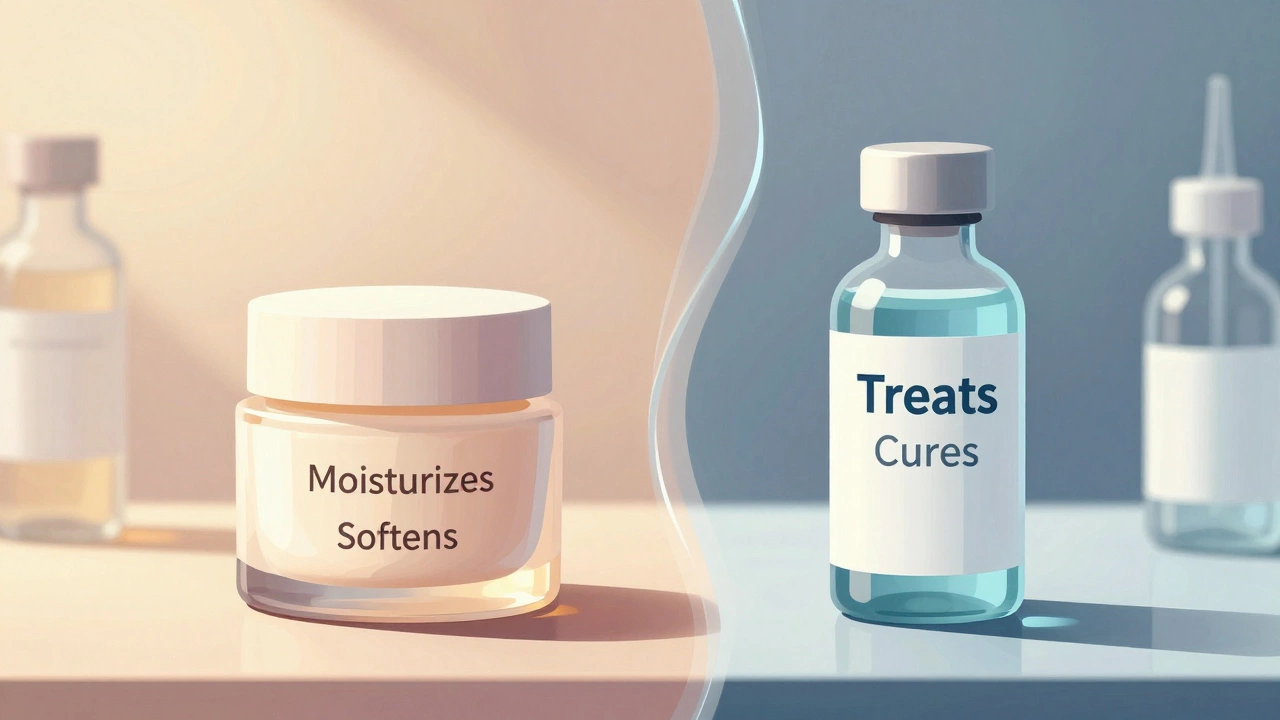
| Claim Language | "Moisturizes," "softens," "cleanses," "colors" | "Treats," "cures," "prevents," "reduces signs of aging" |
For instance, sunscreen is technically a drug in many jurisdictions because it prevents sunburn, which is a medical condition. Regular tanning oil, however, is a cosmetic because it merely darkens the skin without offering protection. Understanding this distinction helps you realize that when you buy a "cosmetic," you are buying a product for maintenance and aesthetics, not medical intervention.
Key Ingredients and Formulations
So, what is inside these tubes and bottles? Cosmetic formulations are complex mixtures designed to deliver specific sensory experiences and functional benefits. While recipes vary wildly, most rely on a few core categories of ingredients.
First, you have emollients and humectants. Emollients, like jojoba oil or shea butter, fill in the gaps between skin cells to create a smooth surface. Humectants, such as glycerin or hyaluronic acid, attract water from the environment into your skin. Together, they provide the "moisturizing" effect we associate with skincare.
Second, there are preservatives. Because cosmetics contain water and organic materials, they are breeding grounds for bacteria and mold. Preservatives like phenoxyethanol or parabens (though controversial) keep products safe from microbial growth. Without them, your expensive serum could turn into a petri dish within weeks.
Third, you find pigments and fragrances. Iron oxides provide color to foundations and blushes, while essential oils or synthetic aromatics create the scent profile. Even "fragrance-free" products often contain masking scents to neutralize the smell of raw chemicals, though they won't list "perfume" on the label.
Safety Regulations and Labeling
One of the biggest misconceptions about cosmetic products is that they undergo the same safety testing as pharmaceuticals. In many regions, including the United States, cosmetics do not require pre-market approval from the FDA. Manufacturers are responsible for ensuring their products are safe, but they don't have to prove it to regulators before selling them.
This places the burden of transparency on labeling. When you pick up a bottle, the ingredient list must follow specific rules. Ingredients are listed in descending order of concentration. This means the first ingredient is present in the highest amount, and the last ones are in the lowest. For example, if water is the first ingredient, it makes up the bulk of the product. If a "miracle extract" is listed near the end, it might be present in trace amounts-just enough to be included in marketing, but too little to have a significant physiological effect.
Additionally, banned substances lists exist. Ingredients like mercury, lead, and certain carcinogenic dyes are prohibited in cosmetics. However, the enforcement varies by country. The European Union, for instance, has stricter bans on over 1,300 substances compared to the roughly 15 banned in the U.S. This is why many global brands formulate to EU standards to ensure their products can be sold worldwide.
Natural, Organic, and Clean Beauty Claims
In recent years, terms like "natural," "organic," and "clean beauty" have become dominant in the cosmetic industry. But what do they actually mean? Surprisingly, very little from a regulatory standpoint.
Unlike food labels, where "organic" is a strictly regulated term requiring certification, "natural" in cosmetics is largely unregulated. A product can be labeled "natural" even if it contains synthetic preservatives or lab-created fragrances, as long as some portion of the ingredients is derived from nature. Similarly, "clean beauty" is a marketing term, not a legal one. It generally implies the absence of certain controversial ingredients like sulfates or parabens, but there is no universal standard for what counts as "unclean."
If you are looking for verified natural content, look for third-party certifications like USDA Organic or Ecocert. These organizations audit supply chains to ensure that a specific percentage of ingredients are grown without synthetic pesticides and processed mechanically rather than chemically. Without these seals, "natural" is just a vibe, not a guarantee.
How to Choose Safe and Effective Products
Given the lack of strict pre-market approval for cosmetics, how do you navigate the shelves safely? Here are practical steps to ensure you are getting quality products.
- Check the Ingredient List: Don't just read the front-of-pack marketing. Look at the back. If you have sensitive skin, avoid products with high concentrations of alcohol denat or strong fragrances early in the list.
- Understand Expiration Dates: Cosmetics degrade over time. Look for the Period After Opening (PAO) symbol-an open jar icon with a number and 'M' (e.g., 12M). This tells you how many months the product remains safe after you first open it. Using expired mascara, for example, increases the risk of eye infections.
- Patch Test New Products: Before applying a new serum to your face, apply a small amount behind your ear or on your inner arm. Wait 24 hours to check for redness, itching, or swelling. This simple step prevents widespread allergic reactions.
- Buy from Reputable Sources: Counterfeit cosmetics are a serious health hazard. Fake products may contain heavy metals, industrial solvents, or incorrect dosages of active ingredients. Stick to authorized retailers and brand websites.
Remember, the goal of a cosmetic product is to enhance your well-being and confidence, not to compromise your health. By understanding what these products are and how they are regulated, you become a smarter, safer consumer.
Is toothpaste considered a cosmetic product?
Yes, basic toothpaste is classified as a cosmetic because its primary purpose is to cleanse and freshen breath. However, if the toothpaste contains fluoride to prevent cavities or treats gum disease, it is also regulated as an over-the-counter drug due to its therapeutic claims.
Do cosmetic products need to be approved by the FDA before sale?
No, with the exception of color additives, cosmetic products and their ingredients do not require FDA pre-market approval. Manufacturers are responsible for ensuring the safety of their products, but they do not need to submit proof of safety to the FDA before selling them.
What is the difference between a cosmetic and a skincare treatment?
The difference lies in the claim. A cosmetic improves appearance superficially (e.g., moisturizing, softening). A skincare treatment acts as a drug if it claims to alter the structure or function of the skin, such as treating acne, reducing wrinkles via collagen stimulation, or curing eczema.
Are "natural" cosmetics safer than synthetic ones?
Not necessarily. "Natural" is not a regulated term in cosmetics. Some natural ingredients, like poison ivy or certain essential oils, can cause severe allergic reactions. Synthetic ingredients are often rigorously tested for safety and stability. Safety depends on the specific ingredient and formulation, not its origin.
Why are ingredients listed in descending order on cosmetic labels?
Regulatory laws require ingredients to be listed by weight, from highest to lowest. This allows consumers to see what makes up the bulk of the product. Ingredients present in less than 1% can be listed in any order after the main components.