Ponytail Facelift Eligibility Checker
Are you a good candidate for a ponytail facelift?
This tool assesses your eligibility based on the latest medical guidelines. For a final determination, consult with a board-certified plastic surgeon.
A ponytail facelift isn’t a name you hear every day, but if you’re looking for a way to lift sagging skin without a long scar or months of recovery, it might be exactly what you’re after. Unlike traditional facelifts that cut along the hairline and behind the ears, this procedure hides the incision right at the top of your head - where your ponytail naturally sits. That means no visible scars on your face, no telltale lines behind your ears, and results that look natural, not pulled tight.
How the Ponytail Facelift Works
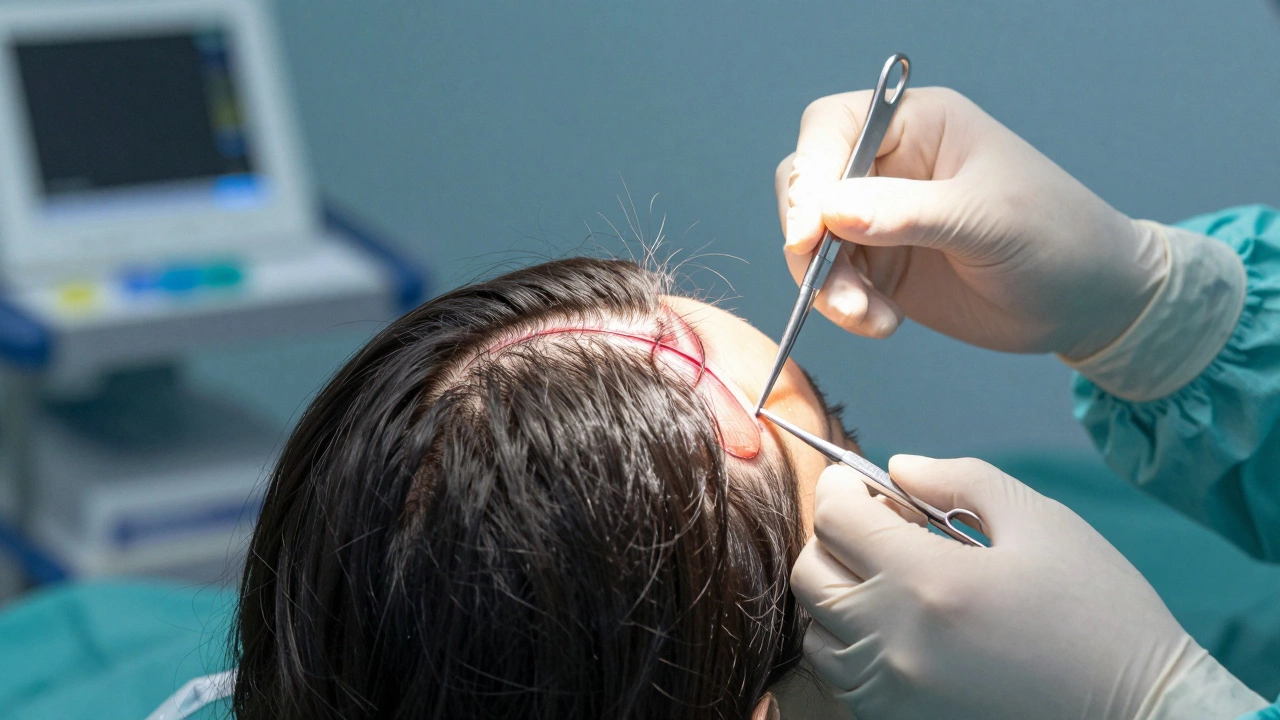
The idea is simple: lift the skin and underlying tissues from above, not below. The surgeon makes a single, curved incision along the crown of your scalp, hidden under your hair. From there, they carefully lift the deeper layers of your face - the SMAS (superficial musculoaponeurotic system) - and reposition them upward and slightly backward. The excess skin is trimmed, and the incision is closed with fine sutures. Because the pull comes from the top, it mimics how your skin naturally moves when you tie your hair back into a ponytail.
This technique doesn’t just tighten skin. It repositions fat pads that have dropped over time, restores volume in the midface, and lifts the jowls and neck without cutting into the lower face. The result? A more youthful contour that looks like you’ve simply lost weight and gotten better sleep - not like you’ve had surgery.
Who Is a Good Candidate?
This procedure works best for people in their late 40s to early 60s who have mild to moderate skin laxity but still have decent skin elasticity. If your neck is starting to show loose skin, your jawline is losing definition, or your cheeks look flatter than they used to, this could be a good fit.
It’s not for everyone. If you have heavy jowls, deep neck bands, or very thin skin from years of sun exposure, a full facelift might still be more effective. Also, if you wear your hair very short or shave your head, this isn’t the right choice - the incision needs to be hidden by hair.
Many people choose this procedure because they want results without the obvious signs of surgery. A woman in her 50s from Auckland I spoke with told me she returned to work after 10 days. Her colleagues noticed she looked refreshed, but no one guessed she’d had surgery. That’s the goal.
Recovery: Less Time, Less Disruption
Recovery from a ponytail facelift is noticeably faster than a traditional facelift. Most people take 7 to 10 days off work. Swelling and bruising are common in the first week, but they fade faster because the incisions aren’t near the delicate skin of the face. You’ll wear a compression bandage for a few days, then a light head wrap at night for another week to protect the incision.
Unlike traditional facelifts, where numbness and tightness can last for months, most patients report normal sensation returning within 4 to 6 weeks. You can wash your hair gently after 48 hours, and most people are back to styling their hair normally within two weeks.
Exercise? Avoid heavy lifting or anything that raises your blood pressure for 3 weeks. Light walking is encouraged after 5 days. You’ll see noticeable improvement by day 14, and final results usually settle in around 3 months.

Results and Longevity
The results last about 8 to 12 years - similar to a traditional facelift. But because the lift is more targeted and natural, it often looks better over time. You won’t get that ‘windblown’ or ‘overdone’ look that some older facelifts created.
One study from the Journal of Plastic and Reconstructive Surgery followed 127 patients who had ponytail facelifts over five years. Nearly 90% reported high satisfaction with their appearance, and 82% said they felt younger than their actual age. The average patient age was 54. Only 5% needed a touch-up procedure within five years.
It’s not a magic fix for wrinkles. Fine lines around the eyes and mouth still need lasers, fillers, or peels. But for sagging skin, jowls, and a softening jawline? This procedure delivers real, lasting change.
Cost and Accessibility
In New Zealand, a ponytail facelift typically costs between $12,000 and $18,000. That includes surgeon’s fees, anesthesia, facility costs, and follow-ups. It’s usually more expensive than a mini-lift but less than a full traditional facelift, which can hit $25,000 or more.
Insurance doesn’t cover it - it’s cosmetic. But some clinics offer payment plans, and a few have partnerships with medical lenders. Always ask for a detailed quote that breaks down every cost. Avoid clinics that bundle in unnecessary add-ons like laser skin tightening or fat grafting unless you’ve discussed them and understand why they’re needed.
Pros and Cons Compared to Other Options
| Feature | Ponytail Facelift | Traditional Facelift | Mini-Lift | Non-Surgical (Threads or Fillers) |
|---|---|---|---|---|
| Incision Location | Scalp crown (hidden in hair) | Temple to behind ear | Small incisions near ear | No incisions |
| Recovery Time | 7-10 days | 2-4 weeks | 5-7 days | 1-3 days |
| Results Last | 8-12 years | 10-15 years | 5-7 years | 6-18 months |
| Scarring Visibility | None (hidden) | Potentially visible | Minimal | None |
| Best For | Mild-moderate sagging, hair-covered scalp | Significant laxity, neck tightening | Early signs of aging | Temporary lift, no downtime |

What to Look for in a Surgeon
This isn’t a procedure every plastic surgeon does. It requires specialized training in scalp and facial anatomy. Ask if they’ve performed at least 50 ponytail facelifts. Look at before-and-after photos - not just the best ones, but a full set. Pay attention to how natural the hairline looks, whether the ears are pulled unnaturally, and if the neck blends smoothly into the jaw.
Check their credentials. In New Zealand, look for surgeons who are Fellows of the Royal Australasian College of Surgeons (FRACS) in plastic surgery. Avoid clinics that push the procedure as a ‘lunchtime lift’ - this is surgery, not a facial.
Common Myths Debunked
- Myth: It pulls your hair back too tight. Truth: The lift is internal. Your hair isn’t pulled - the skin and tissue beneath it are. You can still wear your hair down, in a bun, or in a ponytail without strain.
- Myth: It only works for women. Truth: Men with enough scalp hair and facial laxity can benefit too. Many male patients prefer it because they don’t want visible scars.
- Myth: It’s less effective than a full facelift. Truth: For the right candidate, it’s just as effective - and often more natural-looking.
What Comes Next?
If you’re considering this, start with a consultation. Bring photos of how you looked 10-15 years ago. Be honest about your goals. Don’t just say you want to look younger - say what specifically bothers you. Is it your jawline? Your neck? The hollows under your eyes?
Some people combine the ponytail facelift with eyelid surgery or fat grafting to the cheeks. Others pair it with skin resurfacing treatments later to smooth fine lines. But the facelift itself is often enough.
It’s not the flashiest procedure out there, but it’s one of the most thoughtful. It respects your natural anatomy. It hides its work. And it gives you back the confidence that comes with looking like yourself - just better.
Is a ponytail facelift the same as a mini-lift?
No. A mini-lift usually targets only the lower face and neck with small incisions near the ears. A ponytail facelift lifts from the scalp and addresses the midface, jowls, and neck as one unit. It’s more comprehensive and gives longer-lasting results.
Will I lose hair around the incision?
Temporary thinning can happen right along the incision line, but permanent hair loss is rare. Most patients see regrowth within 3 to 6 months. A skilled surgeon uses techniques that preserve hair follicles, and the incision is placed in an area with dense hair growth.
Can men have a ponytail facelift?
Yes, if they have enough scalp hair to cover the incision. Many men choose this procedure because it avoids visible scars behind the ears or along the hairline. It’s especially popular among men who keep their hair short but not shaved.
How soon can I color my hair after surgery?
Wait at least 4 to 6 weeks. Chemicals in hair dye can irritate the healing incision. Your surgeon will give you a specific timeline based on how your scalp is healing. Always patch-test the dye first.
Does this procedure help with a double chin?
It can, but only if the issue is loose skin and tissue, not excess fat. If you have a lot of fat under the chin, liposuction or Kybella might be added. The ponytail facelift tightens the neck muscles and lifts the skin - it doesn’t remove fat.