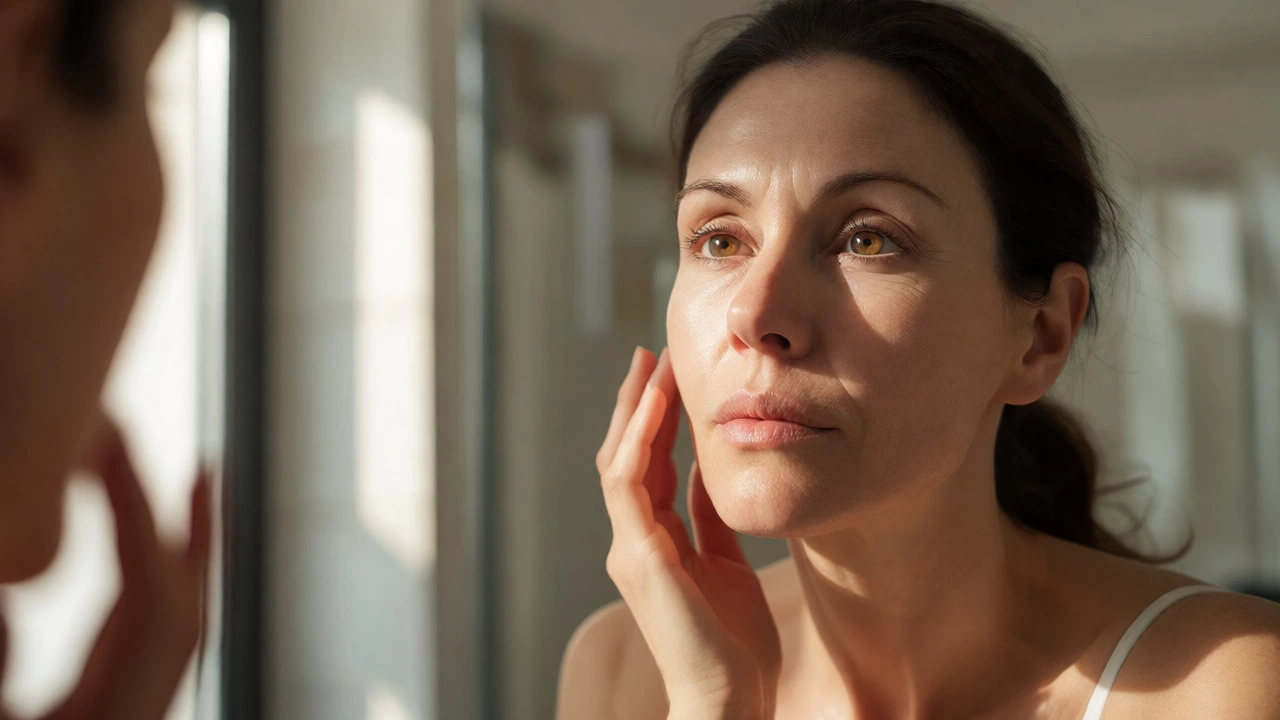
Facial Aging Timeline & Care Guide
Discover what is happening under your skin right now and how to adapt your care routine.
Speed Up Aging
- Sun exposure (UV radiation)
- Smoking (destroys elastin)
- Stomach/Side sleeping (sleep wrinkles)
- Excessive high-impact cardio
Protect Your Face
- Daily SPF 30+ usage
- Back sleeping position
- Consistent hydration
- Retinoids & Antioxidants
You look in the mirror one morning and notice something is different. Maybe your jawline isn't as sharp, or those lines around your eyes seem deeper than they were last month. It’s easy to blame a bad night's sleep or poor lighting, but usually, it’s biology catching up with you. We often hear that facial aging happens gradually, like a slow fade. But science tells a different story. Your face doesn't age in a smooth, linear line. It ages in bursts.
Knowing when these shifts happen can save you money and heartache. Instead of buying every cream on the shelf, you can target the specific biological changes happening at each stage. Let’s break down exactly when your face changes most and what is actually going on under the skin.
The Big Shift: Why Your 30s Are the Turning Point
If you had to pick one decade where things start to visibly change for many people, it’s the third decade of life. This isn’t just about getting older; it’s about a tipping point in your body’s production systems. By the time you hit 30, your skin’s ability to produce collagen and elastin begins to decline significantly. Collagen is the scaffolding that keeps your skin firm. Elastin is what lets it snap back into place after you smile or frown.
Think of your skin like a mattress. In your teens and early twenties, the springs are tight, and the foam is dense. You can jump on it, and it bounces right back. In your 30s, the springs start to loosen. The foam gets a bit thinner. You might not see a sagging mattress yet, but if you put weight on it, it doesn’t bounce back as quickly. That’s what’s happening on your face. Fine lines appear because the skin loses its resilience. Gravity starts to win small battles against your cheekbones and jawline.
This is also when cumulative damage from the sun starts to show up. If you spent your 20s skipping sunscreen, your 30s are when you’ll pay the bill in the form of hyperpigmentation or uneven skin tone. It’s not sudden, but it is noticeable.
The Structural Collapse: Changes in Your 40s and 50s
If your 30s were about surface-level texture, your 40s and 50s are about volume and structure. This is where the term "facial aging" gets serious. It’s not just wrinkles anymore; it’s a shift in shape. As we age, our bones actually shrink. Yes, your skull shrinks. Specifically, the bone mass in the upper jaw (maxilla) and the eye sockets recedes.
When the bone support underneath your skin disappears, the soft tissue above it has nowhere to go but down. This leads to the classic signs of mid-face aging: hollowed cheeks, nasolabial folds (the lines running from nose to mouth), and jowls along the jawline. For women, menopause plays a huge role here. The drop in estrogen levels causes a rapid decrease in skin thickness and moisture retention. Studies suggest that during the first five years of menopause, women lose about 30% of their skin collagen. After that, the rate slows down, but the damage is already done.
Men experience this too, though often later. Their facial fat pads tend to descend rather than dissolve, leading to heavier-looking lower faces. If you’re in this bracket, creams alone won’t fix the structural drop. You need treatments that address volume loss or lift the tissues back into place.
| Age Range | Primary Biological Change | Visible Signs | Best Treatment Focus |
|---|---|---|---|
| 20s | Peak collagen production; cell turnover slows slightly. | Occasional acne scars; fine lines from expression begin. | Prevention: Sunscreen, Retinol, Hydration. |
| 30s | Collagen production drops ~1% per year; elastin weakens. | Fine lines around eyes/mouth; dullness; initial pigmentation. | Texture: Chemical Peels, Microneedling, Antioxidants. |
| 40s | Bone resorption begins; fat pads shift downward. | Nasolabial folds deepen; jawline blurs; static wrinkles appear. | Volume & Lift: Fillers, Ultherapy, Radiofrequency. |
| 50s+ | Rapid collagen loss (menopause); significant bone loss. | Jowls, marionette lines, thinning lips, loose neck skin. | Structure: Facelifts, Biostimulators, Laser Resurfacing. |
Why Some Faces Age Faster Than Others
You probably know someone who looks ten years younger than their birth certificate says they should. And you know someone else who looks tired despite being young. Genetics load the gun, but lifestyle pulls the trigger. While you can’t change your DNA, you can control how much stress you put on your facial structures.
Sun exposure is the single biggest external factor accelerating facial change. Up to 80% of visible facial aging comes from UV radiation. It breaks down collagen fibers and damages DNA in skin cells. If you live in a sunny climate and don’t wear SPF daily, your face will change faster than someone in a cloudy city who protects their skin religiously.
Then there’s gravity and posture. Do you sleep on your stomach? Over decades, pressing your face into a pillow creates permanent creases, often called "sleep wrinkles." These aren’t dynamic lines that disappear when you stop smiling; they are etched into the skin. Similarly, looking down at your phone constantly-often called "tech neck"-can weaken the platysma muscle in your neck, leading to earlier banding and sagging.
Smoking is another major accelerator. Nicotine constricts blood vessels, starving your skin of oxygen and nutrients. It also destroys elastin. Smokers have significantly more wrinkling around the mouth and eyes than non-smokers of the same age. It’s not just a cliché; it’s vascular reality.
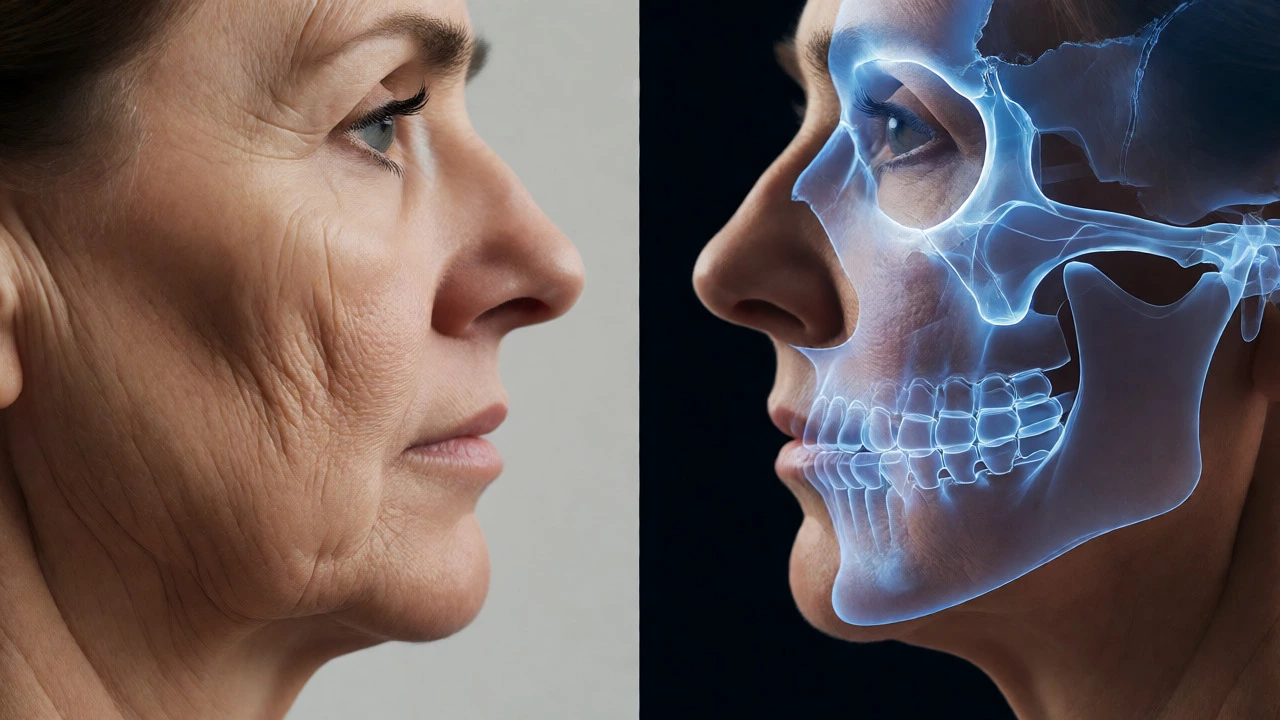
The Role of Fat Loss vs. Skin Sagging
A lot of people confuse two different problems: losing fat in the face versus losing skin elasticity. They require different solutions. In your 30s and 40s, you might lose subcutaneous fat in your cheeks. This makes you look gaunt or tired. It’s not necessarily "old," but it changes the face’s geometry. Conversely, if your skin is lax due to lost collagen, you look droopy.
How do you tell the difference? Pinch the skin on your forearm. If it snaps back slowly, your skin elasticity is low. If your face looks hollow but the skin is still tight, you’ve lost volume. Knowing which issue dominates helps you choose the right treatment. If you have volume loss, adding filler restores youthfulness. If you have skin laxity, adding filler without lifting can sometimes make the face look puffy or heavy. Treating the wrong problem is why some cosmetic procedures fail.
How to Adapt Your Anti-Aging Routine by Age
Since the face changes differently at each stage, your skincare strategy should evolve too. Buying the same moisturizer you used at 22 won’t cut it at 45.
- In your 20s: Focus on prevention. Wear broad-spectrum SPF 30+ every day, rain or shine. Introduce a retinoid (like retinol) at night to boost cell turnover before lines set in. Keep it simple: cleanse, treat, protect.
- In your 30s: Add antioxidants. Vitamin C serums help fight free radicals from pollution and UV rays. Start using peptides to signal collagen production. Consider professional treatments like microneedling to stimulate healing responses in the dermis.
- In your 40s: Hydration becomes critical. Use hyaluronic acid to hold water in the skin. Look for products with ceramides to repair the skin barrier. This is the prime time for energy-based devices like radiofrequency or ultrasound to tighten existing collagen.
- In your 50s and beyond: Richer textures are necessary. Dry skin emphasizes wrinkles. Focus on nourishing oils and heavy creams. At this stage, topical treatments have limits. Procedures like thread lifts, fillers, or surgical options provide the structural support that creams cannot.
Don’t wait until you hate your reflection to act. The best time to start caring for your facial structure was yesterday. The second-best time is today, based on where you are right now.

Common Myths About Facial Aging
Let’s clear up a few misconceptions that waste money. First, expensive creams don’t necessarily work better. A $200 cream isn’t twice as effective as a $100 cream if the active ingredients are similar. Marketing sells packaging, not results. Check for proven ingredients like retinoids, vitamin C, niacinamide, and sunscreen filters.
Second, drinking water doesn’t directly hydrate your skin. Water goes to your organs first. Topical hydration (putting moisture on the skin) matters far more than internal hydration for surface appearance. Drink enough to stay healthy, but don’t expect gallons of water to erase wrinkles.
Third, exercise doesn’t always help your face. Cardio is great for health, but excessive high-impact running can cause repetitive bouncing, which may stretch skin ligaments over time. Strength training is generally safer for facial structure because it builds muscle tone elsewhere, supporting overall posture without jarring the face.
At what age does the face change most dramatically?
While subtle changes start in the late 20s, the most dramatic structural changes typically occur between ages 40 and 50. This period involves significant bone resorption, fat pad descent, and accelerated collagen loss, especially in women due to menopause. However, visible texture changes like fine lines often peak in the 30s.
Does sleeping position affect facial aging?
Yes. Sleeping on your side or stomach compresses facial skin against the pillow for hours. Over years, this mechanical compression can lead to persistent "sleep wrinkles" and asymmetry. Sleeping on your back is recommended to minimize pressure-induced creasing.
Can you reverse facial volume loss with creams?
No. Creams can improve skin texture, hydration, and color, but they cannot restore lost bone or deep fat pads. Volume loss requires injectable fillers, fat grafting, or biostimulatory treatments that encourage new tissue growth. Topicals are too superficial to replace structural volume.
Why do some people look older in their 30s?
This is often due to photoaging (sun damage) accumulated in previous decades, smoking, or genetic predispositions to lower collagen density. Lifestyle factors like chronic stress, poor sleep, and dehydration can also accelerate visible aging markers like dark circles and dullness.
Is Botox only for wrinkles?
Primarily, yes, Botox relaxes muscles to prevent dynamic wrinkles. However, it can also be used for "preventative botox" in younger adults to stop lines from forming, and for medical uses like treating excessive sweating or migraines. It does not add volume or lift sagging skin.
Next Steps for Your Facial Health
Understanding when your face changes empowers you to react wisely. Don’t panic when you see a new line in the mirror. Ask yourself: Is this a texture issue? A volume issue? Or a structural shift? Once you identify the root cause, you can choose the right tool. Whether it’s a consistent SPF routine, a consultation with a dermatologist, or exploring non-invasive tightening treatments, knowledge is your best defense against unwanted aging.